
Crisis To Care Collaborative
from crisis
to care
When someone is experiencing a behavioral or mental health crisis, the right response can make all the difference. The Crisis to Care (CTC) Collaborative is bringing together leaders and partners from sectors across Erie County to build a more coordinated, compassionate, and effective crisis response system for our community.
Crisis to Care Collaborative Releases 2026 Progress Report
The Crisis to Care Collaborative’s 2026 Progress Report outlines Erie County’s coordinated effort to improve how individuals experiencing behavioral health emergencies are identified, dispatched, and connected to care. Built around the national crisis-care pillars of someone to call, someone to respond, and somewhere to go, the report sets measurable 2026 targets aimed at reducing unnecessary arrests and emergency department visits while expanding community-based crisis response options. The report includes the following objectives:
- Double behavioral health call coding: Through updating call-processing systems, expanding countywide coordination, and increasing training for call takers and dispatchers, Erie County aims to double the number of 911 calls accurately coded as mental health-related—from 21,000 in 2024 to at least 42,000 annually. These changes are underway, with full implementation expected to extend beyond 2026.
- Expand access to clinical support: Buffalo EMS has set a 2026 goal of connecting 500 behavioral health-related callers with nurse navigators who can assess needs and guide individuals to appropriate care.
- Expand mobile crisis response: With support from the Patrick P. Lee Foundation, Crisis Services plans to add 19 Mobile Outreach Program staff and increase community assessments from 1,711 in 2024 to approximately 2,925 in 2026.
- Increase use of community-based crisis care: BestResponse, a 24/7 Intensive Crisis Stabilization Center (ICSC) that opened earlier this year in Buffalo, expects to serve 1,800 individuals by the end of 2026. As community-based alternatives expand, the CTC Collaborative aims to reduce annual Comprehensive Psychiatric Emergency Program (CPEP) visits by 1,000.
our goals
To ensure that people in Erie County experiencing a behavioral health emergency receive accessible, effective behavioral health crisis stabilization services and follow-up care.
To reduce the likelihood that people in Erie County experiencing a behavioral health emergency are arrested or inappropriately brought to ECMC’s Comprehensive Psychiatric Emergency Program (CPEP).
understanding the model
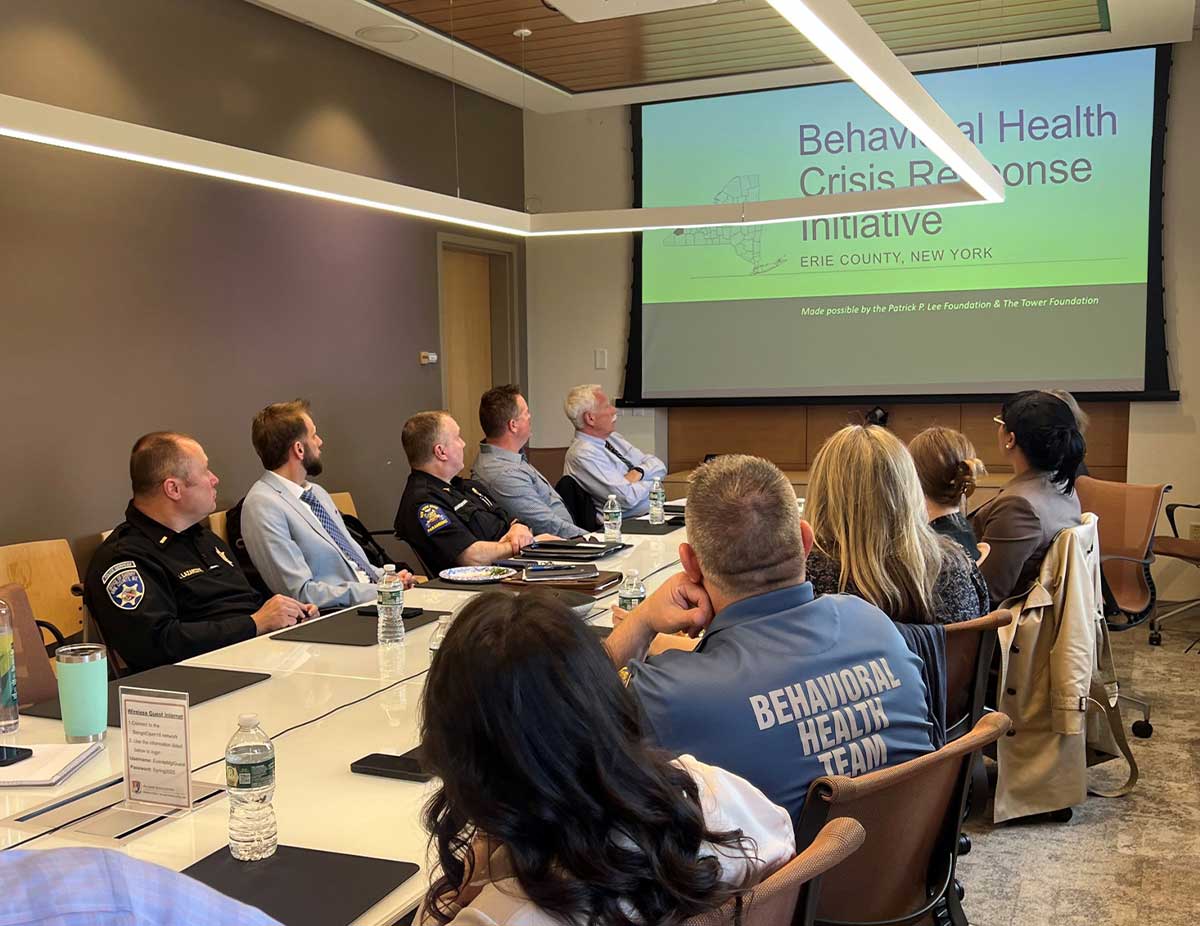
The work of the CTC Collaborative focuses on end-to-end improvements across the behavioral health crisis response continuum—from the initial call through the delivery of care. Our approach is guided by the national framework developed by the US Department of Health and Human Services – Someone to Call, Someone to Respond, and Somewhere to Go.
someone to call
Improving how behavioral health-related crisis calls are identified and process.
someone to respond
Ensuring call takers can dispatch mobile crisis teams and/or co-response units in lieu of a traditional police/fire/
EMS response.
somewhere to go
Improving access to effective stabilization services so that individuals in crisis have a place to go for immediate care.
our approach
The CTC Collaborative will be guided by these core principles:
education
Ensuring all stakeholders and community members have the knowledge they need to navigate behavioral health crises effectively
collaboration
Bringing together law enforcement, first responders, healthcare providers, community organizations, and people with lived experience to create a more effective system
transparency
An open and evolving effort – responsive to community inputs and committed to accountability and continuous improvement
results
Using data to achieve meaningful and lasting improvements to transform a broken system